


For family entertainment centers (FECs) and amusement venues, every minute guests spend waiting in line is time they could be enjoying attractions, making purchases or exploring more of what the venue has to offer.
Long queues are often viewed as a staffing or capacity issue, but the underlying problem may be how technology connects to different parts of the operation. When ticketing, waivers, attraction bookings and point-of-sale (POS) systems operate independently, even simple transactions can require multiple steps.
The result goes beyond guest frustration. Disconnected systems can create missed sales opportunities, underutilized attractions, and unnecessary operational costs.
Reducing these inefficiencies starts with a more connected approach to venue management, one that makes it easier for guests to move between experiences while giving operators greater control over transactions, capacity and revenue opportunities.
Why Long Lines Aren’t Always a Staffing Problem
Consider a family arriving at an entertainment center for an afternoon of activities. They’ve purchased admission online but still need to visit the counter to complete waivers, activate game cards, or reserve attraction time slots. Later, another stop may be required to purchase food or add more activities.
What should be a straightforward visit becomes a series of transactions, with each additional step creating another potential bottleneck.
Behind the scenes, employees may be switching between platforms, entering the same information multiple times or manually verifying purchases before guests can access an attraction. These disconnected workflows also make it harder to track available capacity and offer packages that combine games, attractions and food, and beverages.
At Las Vegas Mini Grand Prix in Nevada, lengthy POS lines were once a significant operational challenge.
“When we were on an old POS system, we used to see lines that would extend through our entire facility and out of our back door,” said Jen Serio, owner of Las Vegas Mini Grand Prix. “We quickly realized that it was not a product of not having as many guests. It was a product of being able to get those guests through our system and through our POS lines much, much faster than we were able to do with our old system.”
Her experience highlights an important distinction: Long lines aren’t always a sign of high demand exceeding capacity. Sometimes, the technology itself is slowing the operation down.
An integrated family entertainment center management system can help eliminate these unnecessary steps by connecting purchases, bookings, and guest information across the venue. Instead of simply processing transactions faster, operators can reduce how many separate transactions are required in the first place.
How Can Amusement Venues Reduce Queues Without Adding Staff?
One of the most effective ways to ease congestion at admission counters is to give guests more control over when and how they purchase their experiences.
Online booking allows visitors to purchase admission, reserve attractions, and complete digital waivers before arriving. Rather than beginning the process at the front counter, families can plan much of their visit in advance.
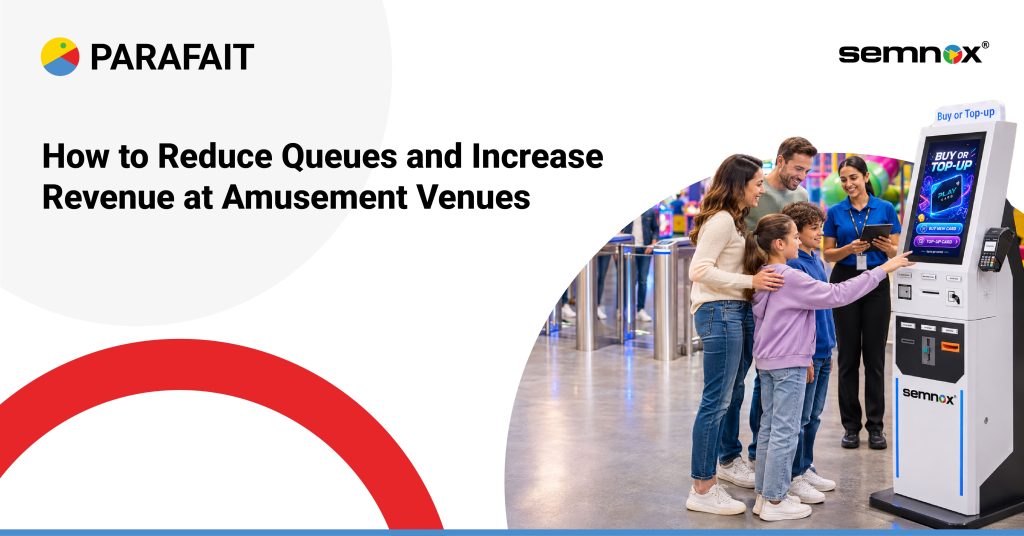
Self-service kiosks extend that convenience onsite. Guests can purchase tickets, recharge game cards and access available products without waiting for cashier assistance, freeing employees to focus on more complex transactions and guest needs.
At GameTime, self-service technology has helped transform the redemption experience, a process that previously created frustration for guests and employees alike.
“The redemption process in the past was slow and painful, often resulting in frustrated parents and staff members, and long lines,” explained Mike Abecassis, CEO of GameTime.
After introducing self-service redemption kiosks, GameTime reported that approximately 55% of redemptions had shifted to the kiosks, reducing the need for staff involvement in prize selection and improving the guest experience.
This illustrates how automation can address bottlenecks beyond the admission counter. Whether guests are purchasing game credits, redeeming prizes or accessing attractions, giving them more opportunities to complete routine transactions independently can help keep the venue moving.
With Semnox Solutions’ Parafait platform, online sales, POS systems, self-service kiosks and RFID-based game and attraction access can operate within a connected environment. Guests benefit from a more convenient experience, while venue teams gain flexibility to direct employees where they are needed most.
Making purchases easier can also encourage additional spending. When guests can recharge cards or add experiences without returning to a cashier’s line, there are fewer interruptions between activities.
Are Your Attractions Reaching Their Full Potential?
A long line at one attraction doesn’t necessarily mean the rest of the venue is operating at full capacity.
For FECs offering timed experiences such as laser tag, ropes courses or virtual reality attractions, managing availability across separate booking channels can make it difficult to accommodate demand efficiently.
An attraction may have unused time slots while another purchasing channel appears fully booked. Without a reliable view of availability, staff can miss opportunities to redirect guests toward experiences that still have capacity.
Integrated attraction scheduling helps address this challenge by connecting reservations and availability across online booking, kiosks, and POS systems.
When a popular attraction reaches capacity for a particular time slot, employees can guide guests toward other available activities. Visitors booking online may also be able to reserve experiences in advance, giving operators a clearer picture of anticipated demand before the day begins.
This flexibility becomes particularly valuable during weekends, school holidays, and other peak attendance periods, when even small scheduling inefficiencies can affect guest flow.
The opportunity isn’t necessarily to accommodate more people at once. It’s to make better use of the attractions, time slots, and resources already available.
Making Every Guest Interaction Count
Shorter queues improve the guest experience, but their value doesn’t end there. Removing unnecessary steps from the purchasing journey also creates opportunities to increase guest spending.
Consider a parent booking a birthday party online. Instead of arranging the party package, food and additional activities through separate transactions, they can select relevant options during the same booking process.
A similar opportunity exists at self-service kiosks, where guests purchasing arcade credits can be presented with recharge promotions or attraction upgrades before completing their transactions.
For operators, the advantage is the ability to introduce these offers at a natural point in the guest journey, when visitors are already making purchasing decisions.
GameTime has also demonstrated the potential of this approach through its use of kiosk-based upselling. By refining how and when offers were presented to guests, the company reported a positive impact on revenue while providing additional value to customers.
Connected systems make these opportunities easier to manage by bringing products, pricing and promotions together across different areas of the venue.
With Parafait, operators can offer combinations of games, attractions, parties and food and beverage while maintaining a more consistent purchasing experience across sales channels.
The relationship can continue after guests leave. Loyalty programs, connected guest profiles and digital engagement tools provide opportunities to encourage return visits through relevant offers and rewards.
The objective isn’t to add more sales messages to every interaction. It’s to make additional experiences easier to discover and purchase without interrupting the fun.
How Can Operators Measure the Impact of Shorter Queues?
Reducing wait times is a worthwhile goal, but operators also need to understand whether those improvements are translating into stronger business performance.
Queue times are an obvious place to start. Tracking how long guests wait at admission counters, kiosks and attraction checkpoints can reveal where bottlenecks occur and whether self-service options or staffing adjustments are making a difference.
Online booking conversion rates provide another perspective. If guests are abandoning purchases before checkout, complicated booking steps or limited availability may be creating friction before they even arrive.
Revenue performance deserves equal attention. Monitoring average transaction value helps operators understand whether bundled packages, recharge promotions and attraction upgrades are encouraging additional purchases. Comparing results across sales channels can also reveal where guests are most responsive to these offers.
Attraction utilization completes the picture. A venue may experience heavy traffic while still leaving valuable time slots unused. Comparing actual bookings and attendance against available capacity can help management identify scheduling gaps and opportunities to distribute demand more effectively.
These metrics become more useful when operators can evaluate them together rather than pulling information from separate systems.
Parafait’s integrated reporting and business intelligence capabilities help bring transaction and operational data into a more complete view of venue performance. With greater visibility into purchasing patterns, attraction activity and sales trends, operators can make informed decisions about staffing, promotions and future investments.
What Should Operators Look for in an Integrated FEC Management System?
Choosing the right FEC ticketing system requires more than evaluating how quickly it can process a transaction. The technology should support the entire guest journey, from the initial online booking to purchases and activities throughout the venue.
For businesses offering multiple attractions, food and beverage, birthday parties and arcade games, integration is particularly important. A system that connects these functions can reduce duplicate work, simplify reporting and make it easier to introduce new products or promotions.
Scalability should also be part of the conversation. As an entertainment center expands its offerings or opens additional locations, its technology needs to accommodate that growth without introducing another collection of disconnected platforms.
Reliable support matters just as much. When systems manage critical daily functions, operators need a technology partner that understands the demands of high-volume entertainment environments and can help them adapt as their business evolves.
Ultimately, the right family entertainment center management software should do more than manage transactions. It should give operators the flexibility to improve the guest experience while supporting more efficient, profitable operations.
When the Lines Move, Business Moves
For amusement venues, reducing queues and increasing revenue are closely related goals. Every unnecessary transaction creates friction, and every avoidable delay represents time guests could spend enjoying another attraction or exploring additional experiences.
Semnox Solutions’ Parafait platform connects online booking, POS, self-service kiosks, cashless payments, attraction management, food and beverage and business intelligence within a unified venue management system.
By simplifying the processes behind the guest experience, operators can make better use of their resources, improve operational visibility, and create more opportunities for revenue growth.
The less time guests spend navigating transactions, the more time they have to enjoy everything a venue has to offer.
Discover how Parafait can help reduce operational bottlenecks and create a more connected guest experience.
FAQ’s
1. How can amusement parks increase revenue without increasing ticket prices?
Amusement parks can increase revenue through bundled ticket packages, food and beverage upselling, membership programs, loyalty rewards, special promotions, and add-on attraction experiences.
2. How does family entertainment center management software help maximize venue revenue?
It helps maximize revenue by streamlining ticket sales, managing promotions, supporting memberships, tracking visitor spending, and providing operational insights that help operators make informed business decisions.
3. What is the best way to manage online bookings at amusement venues?
Using amusement venue booking software allows operators to manage advance reservations, group bookings, ticket availability, and promotional packages. It also helps distribute visitor traffic and plan capacity more efficiently.
4. How do self-service kiosks improve operations at family entertainment centers?
Self-service kiosks allow visitors to purchase tickets, recharge cards, select packages, and make payments independently. This reduces counter congestion and allows staff to focus on guest assistance.
5. How can family entertainment center management software improve operational efficiency?
Family entertainment center management software integrates ticketing, POS, bookings, access control, cashless payments, and reporting into one platform. It helps operators streamline daily operations and manage visitor traffic more effectively.